
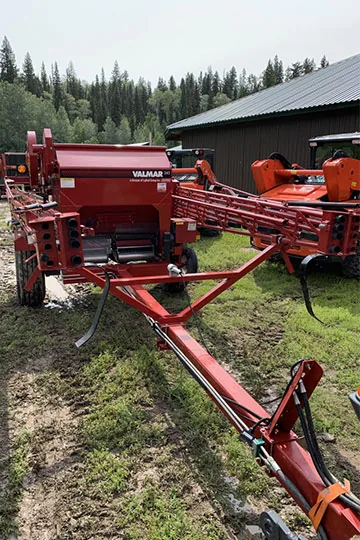
Direct answer: Agricultural machinery bearings must match sealing, mounting, shaft fit and field contamination conditions as well as boundary dimensions. Nexans Bearing supplies tractor, implement and agricultural replacement references for distributors and service networks.
Field conditions make sealing and mounting part of the bearing specification.
Agricultural equipment operates with dust, soil, moisture, crop residue, vibration and seasonal peaks. A bearing that performs in a clean factory test may still fail early in a combine, seeder or tillage implement if the sealing and mounting arrangement do not suit the field environment.
Nexans Bearing supplies replacement and OEM bearings for agricultural distributors, equipment-maintenance teams and aftermarket wholesalers. The range includes tapered roller, deep groove ball, spherical roller, pillow block and specialized agricultural bearing types.
Applications across the equipment cycle.
Planting and seeding
Seed drills and planters use compact bearings in gauge wheels, closing wheels, seed meters and row-unit assemblies. Dust and seed-treatment residue can attack seals and running surfaces. Replacement selection should confirm the mounting method, seal type and axial location.
Harvesting
Combines and forage harvesters use bearings in cleaning systems, augers, elevators, choppers and drive components. Shock load, vibration and crop material create a difficult combination. Spherical roller bearings can tolerate shaft deflection and misalignment in some heavy assemblies, while sealed ball and specialized units are common in smaller mechanisms.
Tillage and soil engagement
Discs, packers, rollers and soil-engaging tools need bearing arrangements that keep contamination out and withstand impact. Housings and sealing systems are as important as the bearing itself. If the housing is worn, replacing only the insert or bearing may not restore service life.
Baling and material handling
Balers and handling equipment combine high load, contamination and intermittent operation. Tapered roller and spherical roller designs may be used in major drive points, while smaller sealed bearings support guides, rollers and feeding mechanisms.
Replacement review beyond dimensions.
Two bearings may share bore and outer diameter but differ in width, seal, clearance, cage, lubrication and housing retention. For agricultural equipment, our RFQ review can include:
- Equipment make, model and mounting position.
- Original bearing or OEM part number.
- Photo of the bearing, housing and failed surfaces.
- Operating conditions and maintenance interval.
- Required seal, lubrication and clearance features.
- Seasonal demand and repeat-order quantity.
Supply for distributors and service networks.
Agricultural parts distributors often support several equipment brands and model generations. A practical supply program combines reference matching, mixed-order consolidation and packaging that keeps small parts identifiable in a warehouse. We can supply neutral packing or develop a private-label route for recurring ranges.
Reduce repeat failures.
If a bearing is failing repeatedly, the bearing itself may not be the root cause. Check shaft condition, housing wear, alignment, lubrication, seal damage and mounting preload. Our team can use photos and application details to help narrow a replacement, but the equipment manufacturer’s service procedure remains the primary reference for installation and safety.
Discuss an agricultural bearing
Frequently asked questions
What causes agricultural bearings to fail early?
Contamination, damaged seals, inadequate lubrication, shaft misalignment and impact load are common causes. The replacement bearing and mounting arrangement should be reviewed together.
Can you match a bearing from an equipment part number?
Yes. Send the equipment make and model, OEM part number, dimensions and photos. We will check the bearing family and available comparable options.
Are sealed bearings available for wet or dusty conditions?
Sealed and protected variants can be reviewed depending on the bearing family and required dimensions. The operating environment should be included in the RFQ.